Ethnobotanical Study on the Utilization of the Zingiberaceae Family in Kampung Kandang, Duren Seribu, West Java, Indonesia
Keywords:
Ethnobotany, Medicinal Plants, Rhizomes, West Java, ZingiberaceaeAbstract
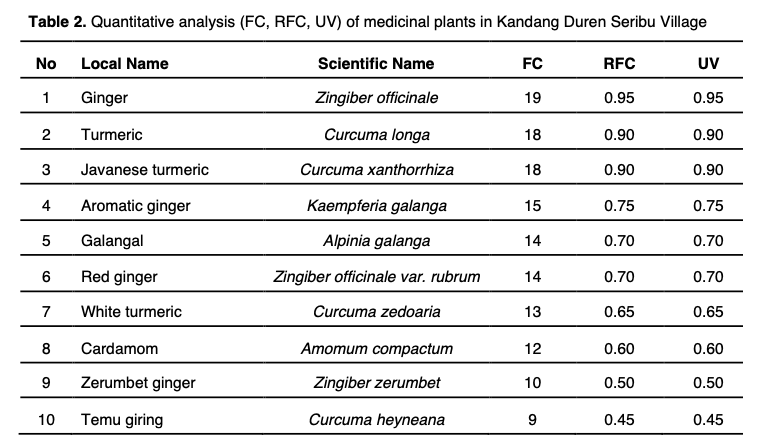
Family medicinal plants occupy an important position in Indonesia's traditional health system, particularly in rural areas that continue to uphold plant-based medicinal practices. The Zingiberaceae family is among the most frequently utilized plant groups, valued both as medicine and spice owing to the bioactive compounds contained in its rhizomes. This study aimed to identify the species, patterns of utilization, and level of importance of Zingiberaceae plants in community health practices in Kandang Duren Seribu Village, West Java. Data were collected through semi-structured interviews and field observations involving 20 informants, comprising 15 general informants and 5 key informants, selected using a purposive sampling technique. Quantitative data were analyzed using 3 quantitative ethnobotanical parameters, Frequency of Citation (FC), Relative Frequency of Citation (RFC), and Use Value (UV), commonly employed to assess species importance. The results recorded 10 Zingiberaceae species used as traditional medicine, with the rhizome being the plant part most commonly utilized. Zingiber officinale obtained the highest RFC and UV values of 0.95, followed by Curcuma longa and Curcuma xanthorrhiza, each with a value of 0.90. Moderately valued species such as Kaempferia galanga, Alpinia galanga, and Zingiber officinale var. rubrum continue to play a role in addressing common complaints such as cough, stomachache, and reduced immunity. Zingiber zerumbet and Curcuma heyneana recorded the lowest values, yet the community continues to maintain their use for specific needs such as diarrhea and menstrual regulation. This utilization pattern reflects a fairly strong consensus of local knowledge alongside variation in knowledge mastery among community members.
Downloads
Published
How to Cite
Issue
Section
License
Copyright (c) 2026 Tanisha Qistimaila, Nurhadiyanta

This work is licensed under a Creative Commons Attribution-NonCommercial 4.0 International License.