Ethnobotanical Inventory of Home Garden Plants in Bambu Kuning Village, Pekanbaru, Indonesia
Keywords:
Ethnobotany, Home garden, ICS, Local Knowledge, UVsAbstract
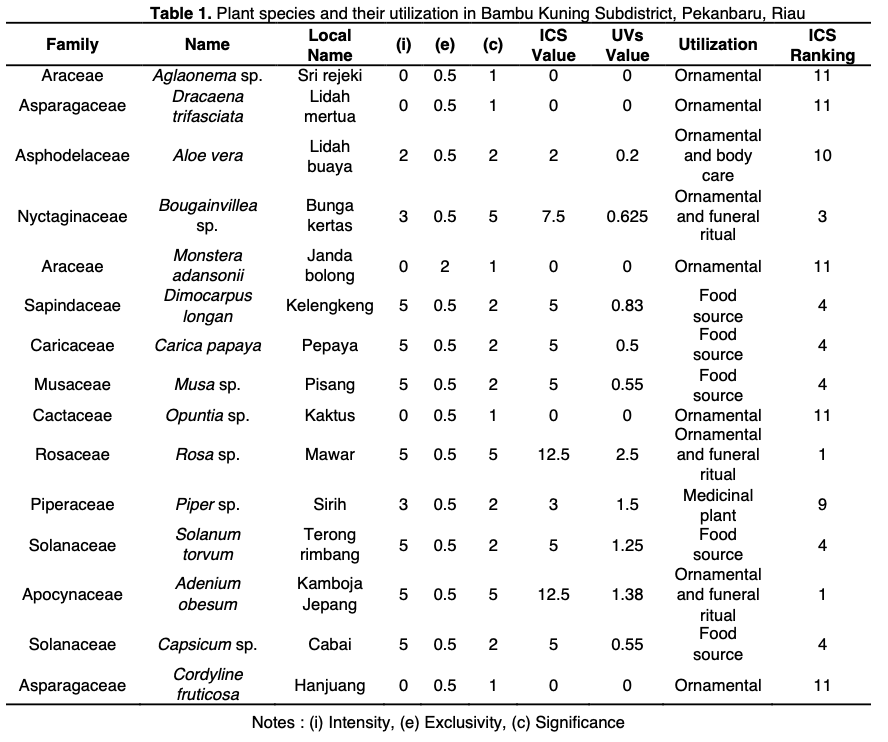
Ethnobotany quantitatively examines the complex interactions between urban communities and plant re-sources, reflecting the adaptation of local knowledge and cultural values amidst rapid environmental changes. In urban areas, home gardens play a vital role as reservoirs of biodiversity and repositories of traditional wisdom, yet quantitative assessments of their cultural and utilitarian values in rapidly urbanizing Indonesian cities remain limited. This study aims to document the plant species found in home gardens, their utilization patterns, and to assess their use value and cultural significance in the Bambu Kuning Sub-district, Pekanbaru City. The research was conducted from December 2025 to January 2026. Data were collected through purposive sampling involving 20 informants selected based on their experience in plant management and a minimum residency of over 10 years in the area. Data were analyzed quantitatively using Use Value (UVs) and the Index of Cultural Significance (ICS). The results identified 15 dominant plant species utilized for ornamental (40%), food (33%), medicinal (7%), and ritual (20%) purposes. Roses (Rosa sp.) and desert roses (Adenium obesum) recorded the highest ICS values (12.5) and UVs (2.5 and 1.38, respectively), whereas purely ornamental plants such as Aglaonema sp. showed the lowest values (ICS: 0; UVs: 0). This study demonstrates that cultural meaning and utilization intensity significantly influence the sustainability of home garden plants.
Downloads
Published
How to Cite
Issue
Section
License
Copyright (c) 2026 Rahma Hijriyah Island

This work is licensed under a Creative Commons Attribution-NonCommercial 4.0 International License.