A Predictive Functional Metagenomic Re-analysis of the Marine Plastisphere
Keywords:
16S rRNA amplicon, Denitrification, Functional redundancy, Marine biofilms, MetaCyc, Plastisphere, Predictive metagenomicsAbstract
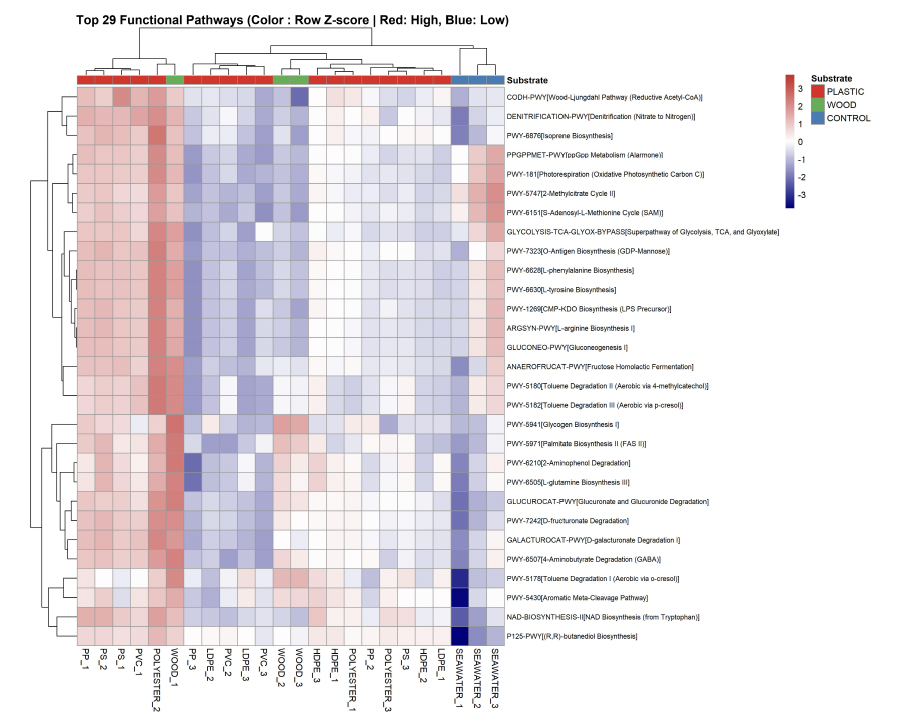
The accumulation of plastic debris in the ocean has created a novel ecological niche known as the "plastisphere." While the taxonomic composition of plastic-associated biofilms has been extensively documented, the functional and metabolic capabilities of these communities remain poorly understood. Accordingly, our study presents a predictive functional metagenomic re-analysis of mature plastisphere communities. We leveraged publicly available 16S rRNA amplicon sequencing data from an in situ colonization experiment originally conducted in the coastal waters of South Australia. This dataset encompassed six commercial plastic polymers, alongside a wood control and ambient seawater. Utilizing the PICRUSt2 predictive pipeline and ALDEx2 for rigorous compositional data analysis, we evaluated the overarching metabolic structure and identified differentially abundant pathways. Results revealed a profound global functional redundancy across all substrates (PERMANOVA, p = 0.703), indicating that the core metabolic machinery of the marine microbiome remains fundamentally stable regardless of the attachment surface. Despite this macroscopic redundancy, micro-scale metabolic specializations were evident, with 29 specific pathways exhibiting significant differential abundance (FDR-adjusted p = 0.047). The plastisphere exhibited a massive enrichment in anaerobic respiration (denitrification) and alternative carbon fixation (Wood-Ljungdahl pathway), suggesting the development of hypoxic micro-niches within the mature biofilm matrix. Conversely, a significant depletion in the ppGpp alarmone metabolism pathway implied alleviated nutritional stress on plastic surfaces, corroborating the plastisphere contribution in trapping and concentrating organic nutrients. These findings underscore that while the plastisphere shares a broad functional framework with the surrounding ocean, plastic surfaces actively trigger specific, highly localized metabolic adaptations critical for biofilm survival.
Downloads
Published
How to Cite
Issue
Section
License
Copyright (c) 2026 Hudzaifah An-naufal Fazasmara

This work is licensed under a Creative Commons Attribution-NonCommercial 4.0 International License.