Utilization of Plants in the Turun Mandi Tradition as an Ethnobotanical Heritage of the Nagari Sijunjung Community, West Sumatra
Keywords:
Ethnobotany, Turun mandi, Plant diversity, West Sumatra, MinangkabauAbstract
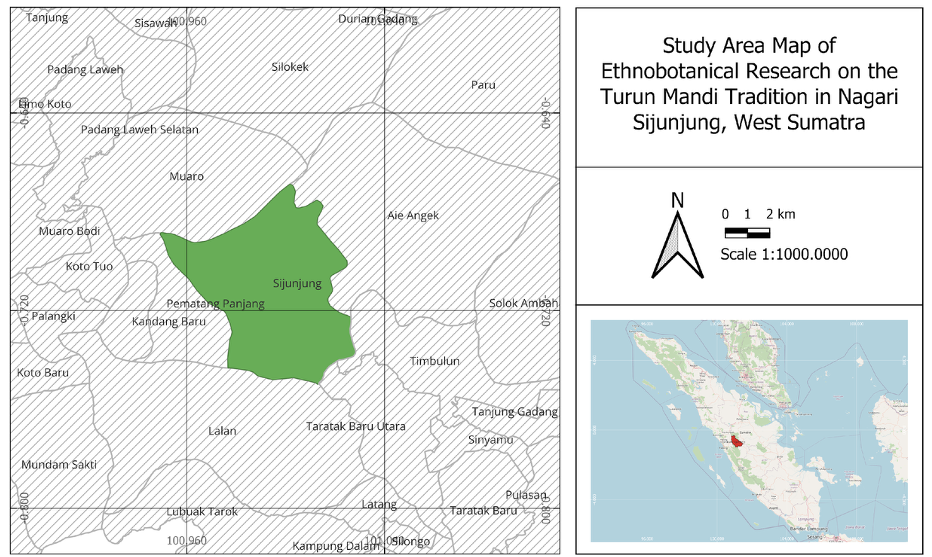
The turun mandi tradition in Nagari Sijunjung, West Sumatra, is a postnatal ritual that expresses gratitude for the birth of a child while serving as a medium for intergenerational transmission of ethnobotanical knowledge. This study aimed to identify the diversity of plant species used, their modes of utilization, and their symbolic meanings within the ritual. A descriptive exploratory research design was employed, with data collected from December 2025 to January 2026 through semi structured interviews with ten informants, including dukun bayi and bundo kanduang aged over fifty five years and mothers aged thirty to fifty five years who had performed the ritual for their newborns. The results documented nineteen plant species used across ritual stages, with leaves, flowers, and fruits being the most frequently utilized plant parts due to their regenerable properties. Plants were applied through immersion, burning, and incorporation into ritual materials, and each species carried symbolic meanings related to protection, purification, moral values, and gratitude linked to biological characteristics. Ritual stages such as baiyo iyo and mangatoan urang, mandi ka sumua, and nail and hair cutting reflected an integrated ethnobotanical knowledge system in which plant functions are embedded within social, moral, and spiritual community values. The continuity of this knowledge depends on dukun bayi and bundo kanduang, with mothers maintaining transmission at the household level. However, modernization, lifestyle changes, and limited documentation pose risks of knowledge erosion. Documentation is essential for cultural preservation and biodiversity conservation efforts locally.
Downloads
Published
How to Cite
Issue
Section
License
Copyright (c) 2026 Putri Balqis

This work is licensed under a Creative Commons Attribution-NonCommercial 4.0 International License.