MaxEnt Projections of Green Sea Turtle (Chelonia mydas) Habitat Suitability in the Indonesian Archipelago under CMIP6 Climate Scenarios
Keywords:
Chelonia mydas, , Climate change, CMIP6, Habitat suitability, Indonesian Archipelago, MaxEnt modeling, Primary productivityAbstract
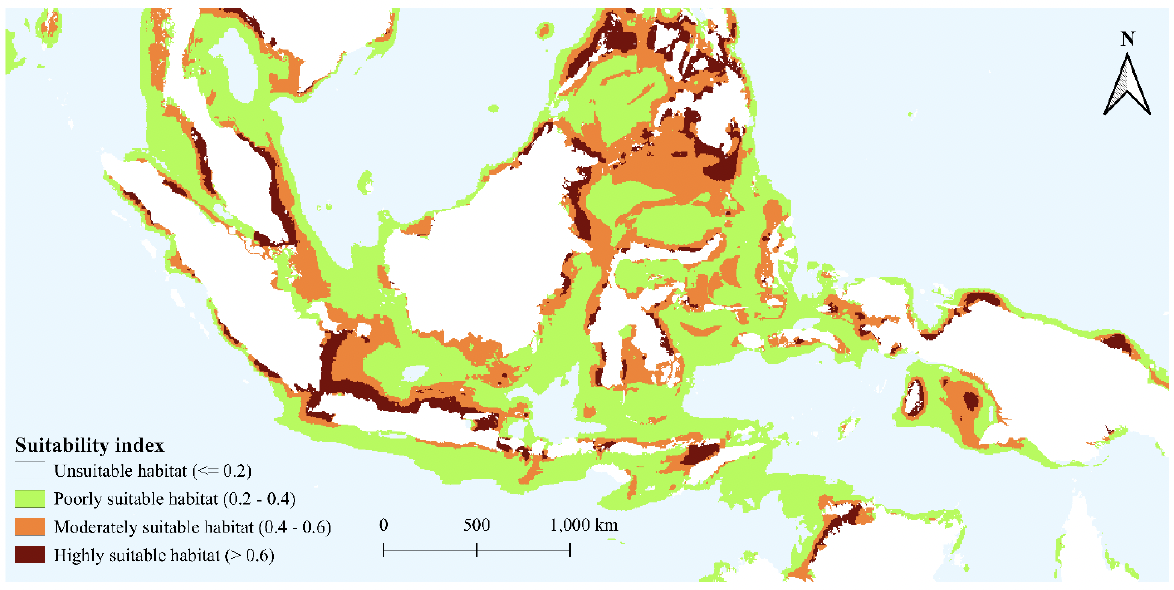
The Indonesian Archipelago serves as a critical global stronghold for the green sea turtle (Chelonia mydas), yet the stability of its marine habitats is increasingly threatened by rapid climatic shifts. This study utilized Maximum Entropy (MaxEnt) modeling to evaluate current habitat suitability across Indonesian waters and projected potential distribution shifts under CMIP6 climate scenarios (SSP1-1.9, 2-4.5, and 5-8.5) for the 2045s and 2065s. Based on 446 curated occurrence records, primary productivity was identified as the most influential environmental driver, underscoring the species' specialized reliance on nutrient-rich neritic zones for foraging. Current high-suitability habitats are concentrated along the southern coast of Java, eastern Sumatra, and the Arafura Sea. However, future projections indicate a catastrophic habitat contraction across all tested pathways. By the 2065s, the high-emission SSP5-8.5 scenario predicts a net habitat loss of 81.57%, while even the sustainable SSP1-1.9 pathway shows reductions exceeding 73%. These findings reveal a "tropical squeeze" where minimal habitat gains fail to offset massive coastal losses, suggesting that climate inertia may already be pushing environmental variables beyond the species' physiological thresholds. The results emphasize an urgent need to pivot from static conservation to dynamic, climate-adaptive management that prioritizes identified refugia and mitigates local stressors to ensure the long-term persistence of C. mydas within Indonesian Archipelago.
Downloads
Published
How to Cite
Issue
Section
License
Copyright (c) 2026 Hudzaifah An-naufal Fazasmara, Paulina Jeany Rosalin, Aura Annisa Rahma, Rafael Raditya Prabowo

This work is licensed under a Creative Commons Attribution-NonCommercial 4.0 International License.